
Khushi Baby strengthens public health systems by closing the gap between data, insights, and action — particularly at the last mile of service delivery.
Khushi Baby operates as a technical partner to ministries of health — working in a build-operate-transfer model that scales through existing government systems rather than building new ones alongside them.
This keeps operating costs low, builds local ownership at every level of government, and produces a model that the state can adopt, fund, and run independently.
Our growth follows government demand, unmet need, and invitation from partners already working in a geography. Where we operate, we aim to go deeper before we go wider.
Approach
Build · Operate · Transfer
Partners
State and national ministries of health
Framework
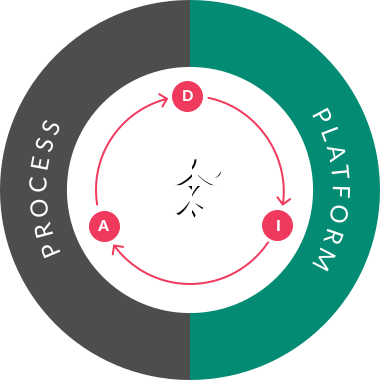
Data · Insights · Action
Presence
Rajasthan · Maharashtra · Karnataka
We deploy a technology platform (CHIP) and an embedded process (Health Action Centers) to complete the Data–Insights–Action feedback loop.
A unified, offline-ready platform co-designed over 250,000 field hours. CHIP consolidates the entire work requirement of frontline health workers across all primary care programs into a single interface — reducing 800+ indicators across 12 national health programs.
More about CHIPA lean, multidisciplinary unit embedded within government health departments. HACs identify the primary health priorities within a geography, conduct a structured gap analysis across the DIA cycle, then co-design, implement, and iteratively refine targeted interventions with government and local partners.
More about HACEvery deployment begins by sitting with district and state officials to identify the most pressing health priority — whether maternal mortality, child malnutrition, TB, immunisation gaps, or another program. We establish a baseline, identify where the care cascade breaks, and define what closing the loop looks like here. This is not a rapid assessment. It takes time, field visits, and co-design with community health workers — who understand the barriers to care that no dashboard will ever surface on its own. The question we start with is: what needs to happen to solve the problem.
Before a single data point is collected, we work with government counterparts to agree on entry and exit strategies, operationalize MoU terms, and integrate with existing digital portals. A clear mandate to reduce duplicate data entry for health workers — not add to it — is a non-negotiable starting condition. This means training and supporting community health workers and officials, developing government budget lines for long-term ownership, and ensuring the digital infrastructure serves people rather than fragmenting their work further. The enabling environment is as important as the platform itself.
Community health workers use CHIP to enumerate every household across the geography — establishing a live registry of named, located individuals that every health program can track over time. This is the substrate on which all insights and actions depend. Without it, targeting is directional at best. The census maps multi-dimensional vulnerability — social, economic, geographic, and health — and integrates with national platforms so data collected once flows across programs rather than being re-entered multiple times.
Raw data becomes actionable through AI and GIS dashboards that show where high-risk populations are concentrated, where referral loops are breaking down, and which individuals need follow-up before their window closes. Insights flow to officials at block, district, and state level — including health secretary and chief minister offices — and are directly linked to action scheduling. Supportive supervision structures for community health workers, live data quality monitoring, and an inbound and outbound call center ensure the system doesn’t stall at the insights layer.
In districts identified by NITI Aayog and government as top-priority and aspirational geographies, Khushi Baby co-establishes a Health Action Center with the health department. A lean interdisciplinary unit is proximally deployed to establish a command center and prioritize closing the public health feedback loop — building on our COVID-19 pandemic response experience and mimicking the urgency of those war rooms. The HAC does not replace government health workers. It coordinates them. Care escalations, referral follow-ups, and daily outreach that would otherwise fall through the cracks are tracked, acted on, and measured.
Closing the loop at the district level creates evidence and tools that travel further — informing policy at state and national level, enabling partner organizations to reach communities Khushi Baby cannot, and building a continuously improving evidence base for what works in public health.
The knowledge gained from running our model gets transferred onto a playbook to replicate at scale. This allows us to adapt it to multiple health programs: reproductive, maternal, neonatal and child health and nutrition, non-communicable diseases, tuberculosis, infectious and vector-borne diseases, immunizations, climate and health.
The goal is to make the playbooks versatile enough to be used effectively across various health areas over time, as required.